If you keep going in circles, there’s probably a reason: you haven’t actually resolved the problem.
People ask me all the time:
“Bob, why do my partner and I keep having the same argument?”
The answer is usually pretty simple.
Because you haven’t found a solution.
You haven’t identified a resolution. You haven’t overcome the adversity. Or one—or both—of you isn’t satisfied with whatever was supposedly “resolved” the last time you talked about it.
So guess what?
Here we go again.
Round and round on the relationship merry-go-round.
Maybe the argument is about what you’re having for dinner. What you’re watching on TV. What you’re doing this weekend.
Or maybe the stakes are considerably higher.
Are we going to have another child? Should we buy the house? Where are we going on vacation? How are we spending our money? What are we going to do about the in-laws? How much time should we spend together?
The subject changes.
The process often doesn’t.
You May Not Even Be Arguing About the Real Problem
Here’s where things get interesting.
Sometimes couples haven’t simply failed to solve the problem.
They haven’t actually identified the problem.
You can spend hours arguing about dishes when the underlying issue is feeling unappreciated.
You can argue about money when the deeper issue is security.
You can fight about how much time someone spends at work when the underlying issue is connection.
You can argue about sex when the real conversation is about intimacy, rejection, affection, trust or feeling wanted.
And if you’re working on the wrong problem, you can have the same argument 147 times and still get nowhere.
Then Out Come the Rock’em Sock’em Robots
When we keep going in circles, frustration builds.
Eventually, instead of trying to solve the problem, we start trying to win the argument.
Out come the Rock’em Sock’em Robots.
Defend.
Counterattack.
Blame.
Accuse.
Keep score.
Bring up something from 2007 that supposedly proves your point.
Communication escalates. People say things they don’t really mean—or things they absolutely mean but probably shouldn’t have said that way.
And resentment starts building.
That’s dangerous territory because resentment can become toxic to a relationship.
The original problem is still sitting there unresolved, but now we’ve added another problem: the damage caused by the way we’ve been communicating about it.
So how do we get off the merry-go-round?
Step One: Plant Your Flag
Start by advocating for yourself.
Plant your flag in the ground and explain your position.
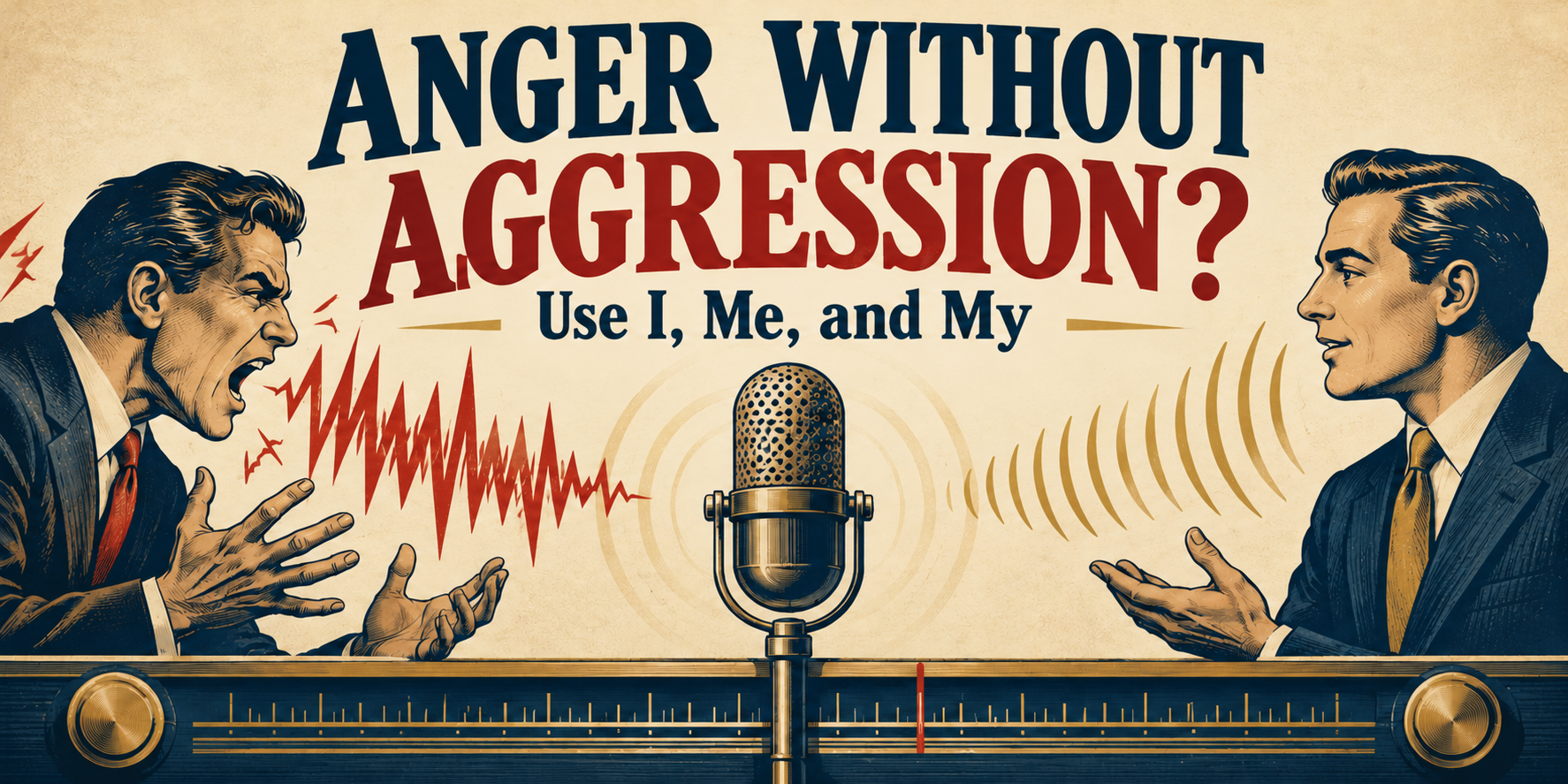
This is where I teach people to use I, Me & My language.
Tell your partner what you are thinking, feeling, wanting, needing and expecting.
For example:
“I’m thinking…”
“I’m feeling…”
“What I would like to see happen is…”
“What would be helpful for me is…”
“What I think might work is…”
“What I need from this situation is…”
You are providing information about your position.
You aren’t prosecuting your partner.
You aren’t telling them what they think.
You aren’t explaining their motives.
You aren’t telling them what is wrong with them.
You’re planting your flag.
Remember the F–YOU Technique
When you’re talking with someone you love—and particularly someone with whom you’re trying to solve a problem—remember my F–YOU technique:
Forget the word YOU exists.
At least while you’re advocating for yourself.
“You never listen.”
“You don’t care.”
“You always do this.”
“You need to change.”
Those statements aren’t really telling your partner about you. They’re telling your partner what you think is wrong with them.
And what happens when somebody feels attacked?
They usually defend themselves.
Congratulations. The Rock’em Sock’em Robots are back.
Instead, stay on your side of the street.
I think. I feel. I want. I need. I expect.
Plant your flag without trying to knock theirs over.
Step Two: Shut Up and Listen
You’ve planted your flag.
Great.
Now take a step back and give your partner the opportunity to plant theirs.
And here’s the hard part:
Listen to understand and reflect—not simply to prepare your response.
Your job isn’t to sit there silently developing your rebuttal.
Listen for what your partner is thinking, feeling, wanting, needing and expecting.
Then demonstrate that you heard them.
Reflect.
Validate.
Acknowledge.
You don’t necessarily have to agree with someone’s position to demonstrate that you understand their position.
That’s empathy.
In practical communication terms, empathy is reflecting back and acknowledging what another person is thinking, feeling, wanting, needing or expecting.
And something important happens when two people can advocate for themselves and provide empathy to one another.
The environment changes.
Instead of:
Me versus you.
You begin moving toward:
Us versus the problem.
Now You Can Find the Middle Ground
Once both of you have planted your flags, something becomes visible that wasn’t visible before.
The space between them.
That’s where collaboration begins.
Now you can ask:
What can I give?
What can you give?
What matters most to each of us?
Where can we compromise?
What isn’t negotiable?
What are we actually trying to accomplish?
What solution can we create that respects both people’s needs as much as reasonably possible?
That’s negotiation.
And negotiation becomes much easier when it follows advocacy and empathy.
In other words:
Advocate → Empathize → Collaborate → Negotiate → Resolve.
You’re no longer arguing simply for the sake of arguing.
You’re trying to accomplish something together.
Get Off the Merry-Go-Round
If you keep having the same argument, don’t automatically assume you have a communication problem.
Ask a different question:
What haven’t we resolved yet?
Then plant your flag.
Advocate for yourself without attacking your partner.
Give them room to plant their flag.
Listen.
Reflect.
Validate.
Find the middle ground.
Then collaborate and negotiate until you’ve developed a resolution you can both live with.
Because relationships aren’t strengthened by never disagreeing.
They’re strengthened when two people learn how to work through disagreement without destroying each other in the process.
And that’s how you finally get off the merry-go-round.

This article is based on a segment from The Bob Zima Radio Showgram, where Bob talks about life, relationships, psychology, anger, healing—and the everyday chaos that comes with being human.
Visit the The Bob Zima Radio Showgram.
Bob Zima, LCPC
Frequent Flyer to Hell & Back
Laugh. Think. Grow. This is life. Let’s talk about it.