By Bob Zima | Based on a segment from The Bob Zima Radio Showgram
Hello, everybody, and welcome back to the beautiful Grumpy Gator Cafe. I’m Bob Zima, the cafe’s resident lunatic, lover, and poet, and your host of the very cleverly named Bob Zima Radio Showgram.
Someone recently asked me a simple question: “Can an app really help me heal my anger?”
My answer: yes, an app can help.
Then came the follow-up: “Is the app all I need?”
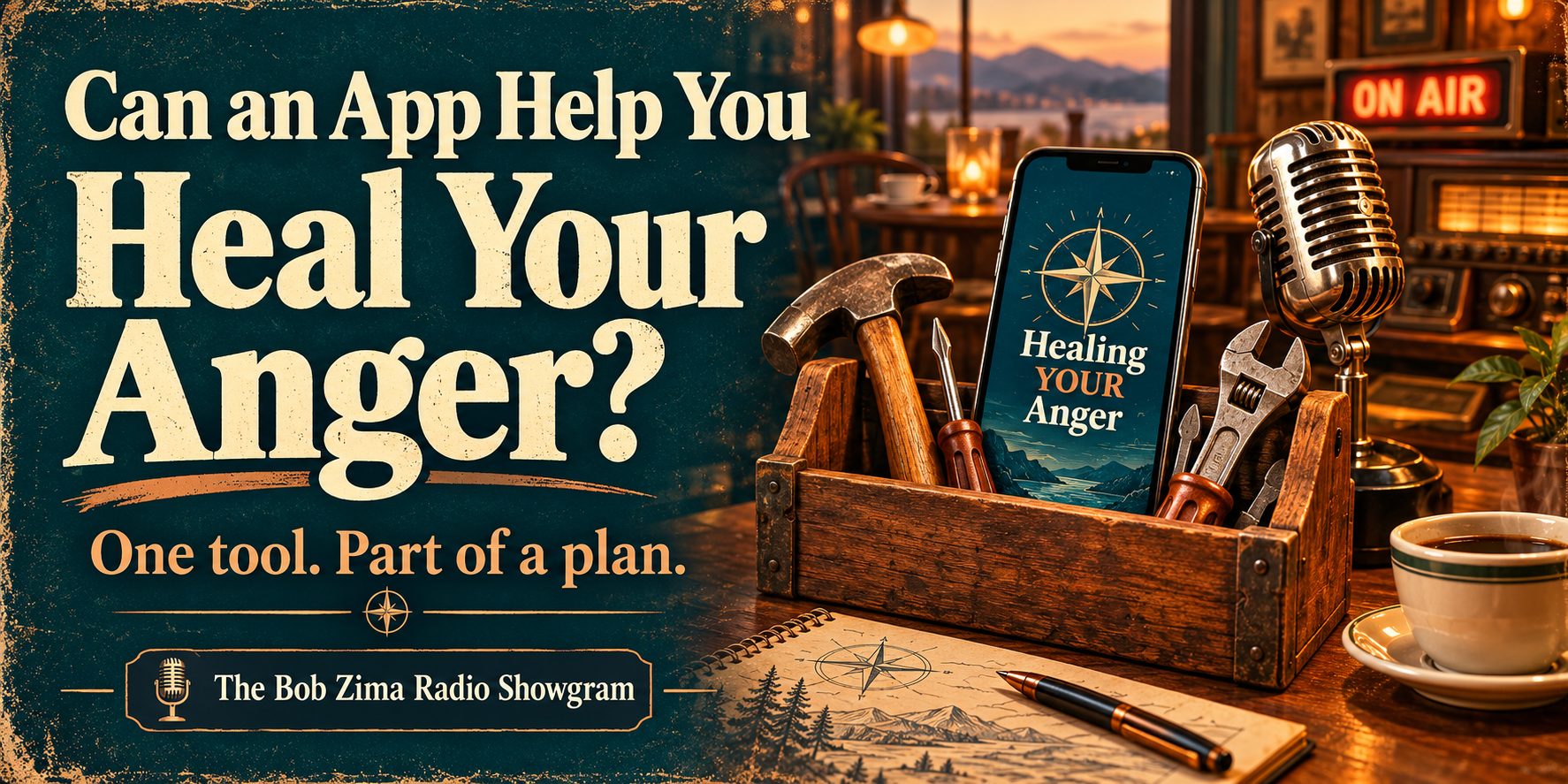
My answer to that: you need a plan. An app can be one of the tools you use to put that plan into action.
You need more than one tool
Have you ever installed a ceiling fan, repaired a toilet, fixed your deck, or tried to level a washer? Usually, you need more than one tool. A screwdriver does one job. A crescent wrench does another. And sometimes you need someone who knows what they’re doing to help you figure out why the darn thing still doesn’t work.
You’ve probably heard the saying: “If all you have is a hammer, everything looks like a nail.”
The same idea applies to developing psychological fitness and healing your anger. An app, counseling, educational podcasts, and blog articles can each contribute something useful. For some people, medication prescribed for an underlying condition may also be part of their care.
The question is how those tools fit together to help you understand yourself, practice different responses, and create better outcomes.
What an anger app can help you do
I created Healing YOUR Anger to help people begin understanding what drives their anger and explore ways to respond differently.
Like counseling or other educational resources, an app can give you a framework for examining your experiences. Instead of stopping at “I got angry,” you can begin asking:
- What happened?
- What did I believe that situation meant?
- What emotions and physical reactions did I notice?
- What did I do next?
- What happened because of that behavior?
- What could I try differently?
Those questions move you toward a plan you can actually use. But reading a lesson or completing an exercise is only the beginning. You also have to practice applying what you learn when life gets uncomfortable.
And life has a remarkable talent for getting uncomfortable.
Why I talk about healing your anger
I use the phrase “healing your anger” because I want to help people examine the process that drives their anger behaviors.
Breathing, taking a step back, or walking away from a heated conversation can be useful. Sometimes creating that pause is exactly what allows you to make a better choice. But I want the work to continue after the immediate situation settles down.
What did you tell yourself about what happened? What expectations were involved? What hurt or fear showed up? Why did yelling, withdrawing, blaming, or demanding seem like the response to make?
If the same thinking and behavior keep producing the same painful outcomes, we need to examine the pattern. Otherwise, we may keep calming down after arguments while returning to the same argument next week.
For me, healing includes understanding that pattern and practicing ways to change it.
Follow the process to understand the outcome
One framework I use connects your interpretation of a situation with your emotional and physical response, your behavior, and the outcome that follows.
Here’s an example. Your partner doesn’t respond to a message. You interpret the silence as “They don’t care about me.” You feel hurt, your body becomes tense, and you send an accusing text. Now you’re in an argument.
Consider another interpretation: “I don’t know why they haven’t replied yet.” You might still feel uncomfortable, but you could choose to wait or ask what happened. That creates an opportunity for a different conversation.
Changing your interpretation doesn’t guarantee that another person will cooperate or that every situation will work out. It can, however, open up more choices about how you respond.
You can also begin by changing your behavior while you’re still upset. You don’t have to wait until every thought and feeling falls neatly into place before making a healthier choice.
The point is to understand where you can intervene in the process and then practice doing it.
Build a plan around the outcomes you want
Anger becomes a serious problem when the ways we express it repeatedly produce outcomes we don’t want: damaged relationships, trouble at work, children who are afraid of us, or consequences that follow us long after the argument ends.
Ask yourself: “What outcome am I trying to create, and is my current behavior helping me get there?”
Your plan might include learning what drives your reactions, practicing a different response, seeking counseling, and reviewing what worked after a difficult interaction. An app can support that work, but using the tool is part of the process. It isn’t the entire process.
You can explore Healing YOUR Anger as the app is in previews. Join the crew for FREE and try the app. If you’re interested in telehealth counseling, visit bobzima.com for information about working with me. Clients must be physically in Illinois during our sessions.
Pick up the tools. Put together a plan. Then practice using it in your everyday life.
That’s where the work of healing happens.