
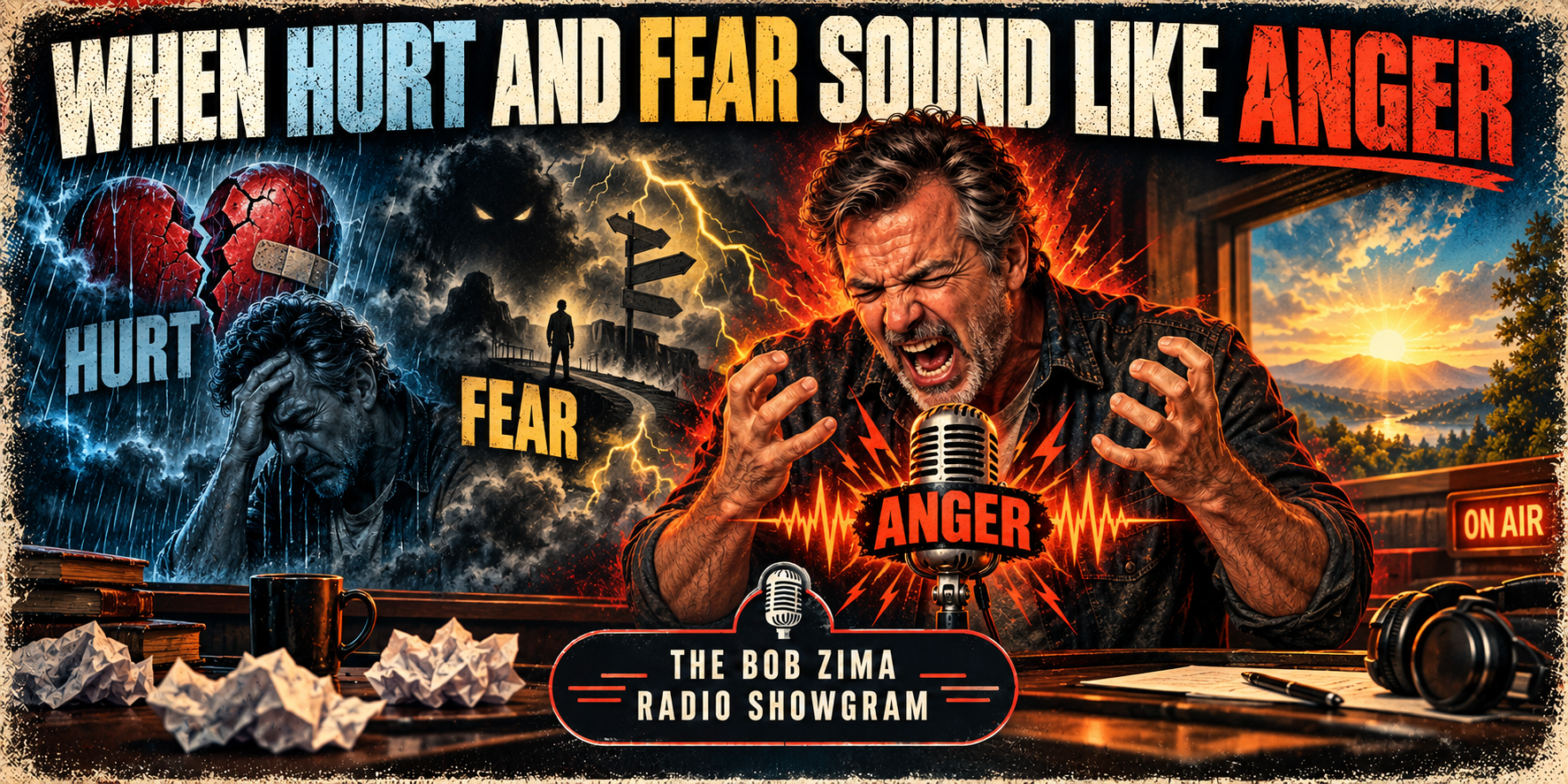
Hurt and fear often sit beneath the yelling, cursing, defensiveness, and other behaviors we call anger. Understanding what is driving the behavior gives us a better chance to change it.

This article is a segment of The Bob Zima Radio Showgram (visit the show).
Hello, everybody, and welcome to the beautiful Grumpy Gator Café. My name is Bob Zima—the café’s resident lunatic, lover, and poet—and you are reading another dispatch from The Bob Zima Radio Showgram. So cleverly named, isn’t it? I’m SO proud of myself.
Today, I want to talk about two powerful human experiences: hurt and fear.
These two emotions often supply the fuel for what we call anger. The anger behavior may be what everyone sees and hears, but underneath the yelling, cursing, punching, withdrawing, blaming, or slamming doors, there is often a person who feels hurt, frightened, threatened, disappointed, rejected, or uncertain.
If we want to change our anger behavior, we need to understand what is feeding it.
The Three-Emotion Framework
I use a simple framework built around three basic emotional experiences: happy, sad, and scared.
Think of them like primary colors. Mix primary colors together and you create many other colors. In the same way, combinations and variations of happy, sad, and scared can help us describe a wide range of emotional experiences.
Take excitement, for example. Excitement can be a mixture of happiness and fear. There is enough happiness to make the experience enjoyable and just enough uncertainty to make us feel energized and alive. That is what makes a roller coaster, a first date, a new job, or a major trip exciting—and sometimes terrifying.
Wouldn’t it be nice if we could simply miss sad and scared instead of mixing them? Unfortunately, life doesn’t work that way.
We experience loss. We face uncertainty. People disappoint us. Relationships change. Jobs end. Plans fall apart. Bills arrive. Health problems show up. Other people do things that make absolutely no sense to us.
We think about what is happening, and those thoughts trigger emotional and physical responses.
We Think, Then We Feel
Life is a continuous stream of events. As something happens, the drive-in theater between our ears immediately starts showing a movie about it.
What does this mean?
What is going to happen next?
Am I safe?
Am I going to lose something important?
Am I being rejected, disrespected, controlled, or abandoned?
Our minds evaluate the situation, predict where it may be headed, and prepare us to respond—often in the blink of an eye. We do not have to ask our emotions to appear. They show up automatically as our minds interpret what is unfolding.
If I believe I am about to lose my job, I may feel scared about my future and hurt by the way I have been treated. If I think a relationship is ending, I may feel sad about the loss and frightened by the uncertainty ahead.
Those feelings are real, even when my interpretation of the situation is incomplete or inaccurate.
The Body Joins the Conversation
When the mind detects a threat, the body prepares to protect us. The heart may beat faster. Breathing may become quicker and shallower. Muscles tighten. The mouth becomes dry. The stomach becomes upset. We may sweat, shake, pace, clench our fists, or feel energy “boiling up” inside.
People often describe that physical surge as feeling angry. But the body may actually be mobilizing in response to hurt, fear, loss, danger, uncertainty, or some combination of them.
That protective stress response may move us toward fighting, fleeing, freezing, or trying to keep the peace. If I believe something important is being taken from me, I may fight to hold on to it. If I believe a confrontation will make matters worse, I may back away. Both responses are attempts to manage what I think is happening.
The problem is that all this emotional and physiological energy needs somewhere to go.
Anger Is What Hurt and Fear Can Sound Like
In my approach, anger is the behavior we use to express and manage what we are thinking, feeling, and experiencing physically.
Sometimes hurt and fear leave the soul noisily.
They can come out as yelling, cursing, blaming, threatening, kicking, punching, or breaking things. They can also come out more quietly through sarcasm, defensiveness, resentment, withdrawal, stonewalling, passive aggression, or the silent treatment.
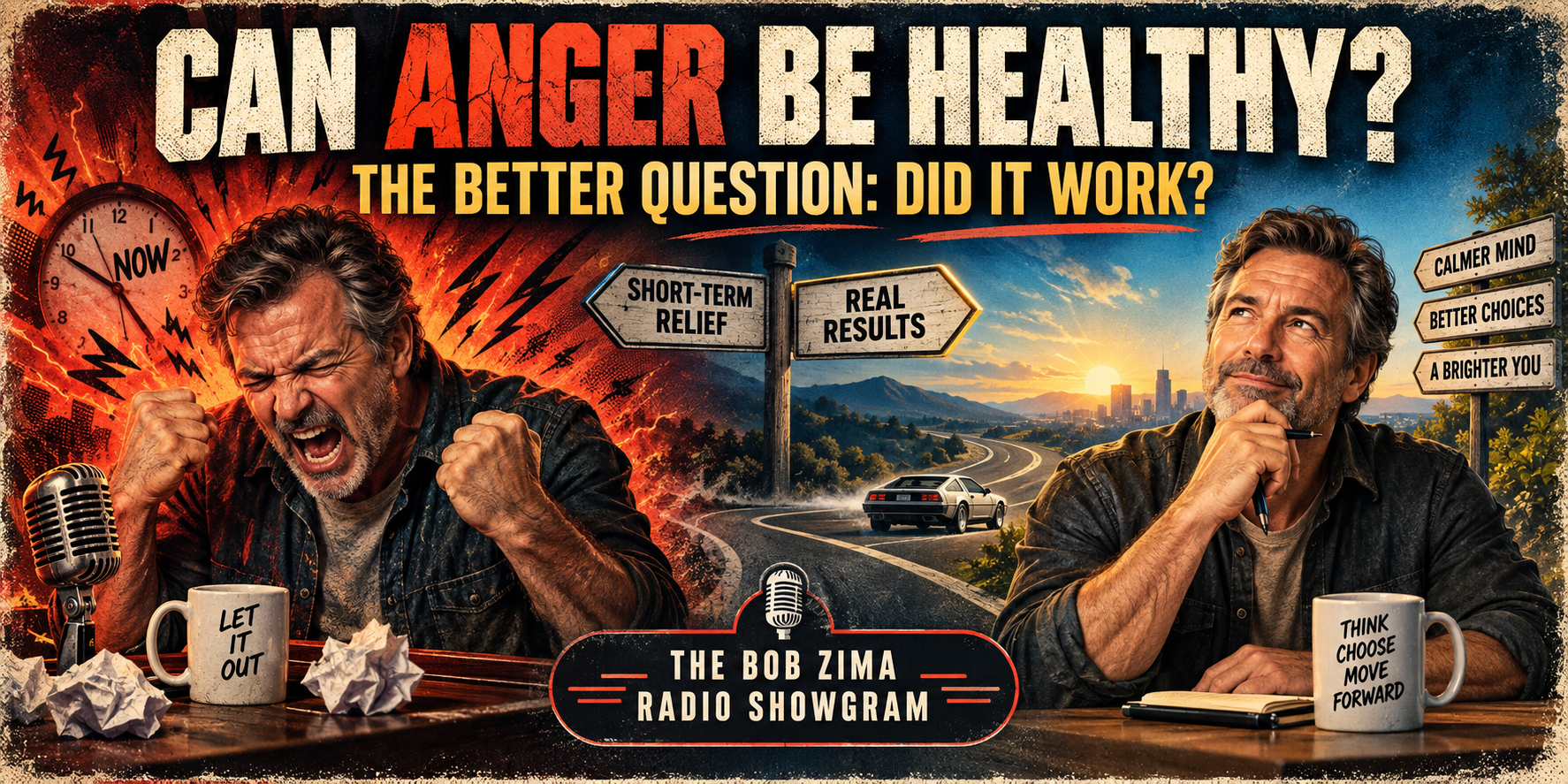
The behavior may provide a brief release. It may discharge some of the physical energy or create the illusion that we are taking control. But a cathartic release is not necessarily a healthy or effective response. It can damage relationships, create new problems, and leave the original hurt or fear untouched.
In other words, expressing anger is not the same thing as healing what drives it.
Get Curious About What Is Underneath
If you want to change an anger behavior, do not stop at, “I was angry.” That tells you what happened on the surface, but it does not tell you what powered the response.
Instead, slow the process down and ask:
- What happened?
- What story did I tell myself about what happened?
- What did I believe I might lose?
- Did I feel hurt, disappointed, rejected, embarrassed, powerless, or afraid?
- What happened in my body?
- What behavior did I choose?
- Did that behavior produce the outcome I wanted?
- What healthier and more effective behavior could I try next time?
These questions are not excuses for harmful behavior. Understanding why you behaved a certain way does not remove your responsibility for what you did. It gives you information you can use to make a different choice.
Turn Down the Noise and Address the Source
Anger behavior is often loud. Hurt and fear are often harder to admit.
It may feel safer to say, “I’m pissed off,” than to say, “I’m scared I’m going to lose you.” It may feel stronger to attack than to admit, “What you said hurt me.” It may feel easier to blame someone else than to acknowledge, “I feel powerless, and I don’t know what to do next.”
But healing begins when we become honest about what is happening beneath the noise.
The next time you feel that energy building—the racing heart, tight muscles, rapid breathing, clenched jaw, or churning stomach—pause before you let the energy select your behavior for you.
Ask yourself: Am I hurt? Am I afraid? Am I both?
Then choose a response that helps you communicate what is really happening and move toward the outcome you actually want.
That is how we begin to calm the storm that drives anger.
Bob Zima is a licensed clinical professional counselor, author, speaker, and host of The Bob Zima Radio Showgram. He offers jargon-free, practical ideas for healing, managing anger, and improving relationships. This article is educational and is not a substitute for mental health treatment, medical care, or emergency services.

Leave a Reply